DSD operations face a scaling problem. Field sales teams grow. Delivery routes multiply. Customer counts increase. The systems that worked for five reps and fifty stores break down at fifty reps and five hundred stores.
Order accuracy drops. Route efficiency suffers. Managers lose visibility into daily operations. Field teams spend more time on admin than on selling. Delivery drivers miss stops or run late.
A top-rated CPG field sales platform with offline capability solves this by connecting field sales, route planning, and delivery execution in one system. Orders flow from capture to delivery without manual handoffs. Managers see real-time activity across the entire operation.
Here are the top 4 platforms built to scale DSD operations.
1. SimplyDepo
SimplyDepo is the best all-in-one DSD and retail execution platform that brings order capture, route planning, van sales, mobile invoicing, and delivery proof into one mobile workspace. Shelf audits, planogram compliance, and photo reporting are part of the same workflow, not separate tools.
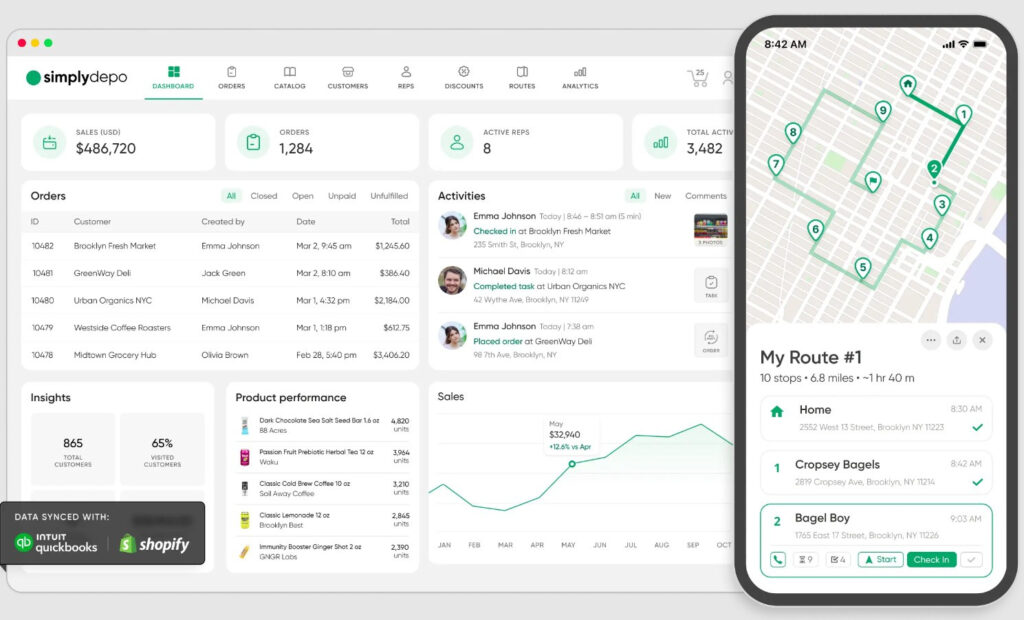
Field reps enter orders from their mobile devices. The same app maps out delivery schedules and optimizes stop sequences. Drivers update delivery status, collect signatures, and invoice customers without leaving their trucks. Merchandisers check shelves, photograph planograms, and document in-store demos during that same store visit.
Offline mode keeps everyone productive in store basements and rural routes. Data syncs automatically when the signal returns. The native QuickBooks Online connection removes the need for CSV exports and double-entry.
A branded B2B storefront gives retailers 24/7 access to products, pricing, and availability. Online orders flow directly into field sales and delivery workflows. SimplyDepo serves CPG brands and distributors with 1 to 100 users across the US and Canada.
Most teams go live within 7 days. Free onboarding and training come with every subscription. This top-rated DSD platform with transparent pricing and no lock-in gives growing teams flexibility to scale without annual contracts.
What Sets It Apart:
- One mobile app for field sales, route planning, delivery, and retail execution
- Offline-first design for rural stores, warehouses, and trade shows
- Native QuickBooks and Shopify sync for accounting alignment
- AI-driven demand forecasting, SKU performance insights, and compliance gap detection
- Storefront syncs with field execution so online orders become delivery stops automatically
What Users Say:
Users consistently highlight the elimination of manual data entry and double work. One customer noted that “with SimplyDepo, manual reporting and QuickBooks reconciliation disappeared.” Another emphasized that the platform “has become the foundation for managing customers, orders, and relationships without relying on spreadsheets.”
Multiple reviewers mention the time savings. A customer reported saving “40+ hours weekly across reps” after switching to SimplyDepo. Another noted that “reporting is now 3x faster and order accuracy climbed to 95%+.”
Field teams appreciate the unified approach. One user commented that “every store visit, task, and photo is captured in one place. We finally have real visibility into what’s happening in the field every day.” Another highlighted that “route inefficiencies quickly disappeared, and we gained clear insight into performance across routes, territories, and daily coverage.
2. Skynamo
Skynamo connects field sales teams to the systems that run the business. The company started in 2012 and operates from Stellenbosch, South Africa, with offices in Johannesburg, Durban, London, and Atlanta.
The mobile app handles visit logging, catalog browsing, and order entry. Inside sales tools and a customer portal round out the platform. Customers submit orders through a branded portal. ERP integrations keep pricing, inventory, and customer data consistent across systems.
Radar AI, the platform’s intelligence engine, runs RFM analysis on customer data. It tracks how recently customers bought, how often they engage, and how much they spend. It flags customers who might be slipping away, products that are picking up speed, and territories that need more attention. The Sales vs. Visits view shows whether rep activity is translating into sales results. Multi-language, multi-currency, and multi-time-zone support come standard.
ISO 27001 certification covers information security. Nearly 1,000 manufacturers, wholesalers, and distributors use Skynamo across Food & Beverage, Beauty & Cosmetics, and Building & Hardware.
What Sets It Apart:
- Radar AI for customer risk scoring and sales intelligence
- Multi-language, multi-currency, multi-time-zone support
- ISO 27001 certified for information security
- Customer self-service portal with order history and tracking
What Users Say:
Users consistently highlight Skynamo’s ease of use and real-time reporting capabilities. One reviewer noted that the platform is “user-friendly and easy to use, even for beginners.” Another praised the “seamless integration with accounting software like Sage and Pastel that streamlines order processing.”
The GPS tracking and real-time visibility features receive particular attention. Managers appreciate “real-time reporting and GPS tracking that provide valuable insights into sales team activity and customer interactions.” One reviewer emphasized the value of being able “to track the productivity of the sales team in real time.”
Multiple reviewers mention Skynamo’s ability to “double – and in some cases triple – the number of customers they visit per week.” Customer support is consistently praised for being responsive and helpful.
Some users point to challenges with system performance. The platform “can be slow to load, especially the timeline.” Integration with certain ERP systems has been described as “challenging” with “complex pricing structures.” Several users noted that the mobile app can be “a battery drain on some devices.”
3. inSitu Sales
inSitu Sales serves wholesale distributors with a field sales, delivery, and warehouse platform. Founded in 2017 and headquartered in Los Angeles, California, the company targets SMB wholesalers who need order management and delivery in one system.
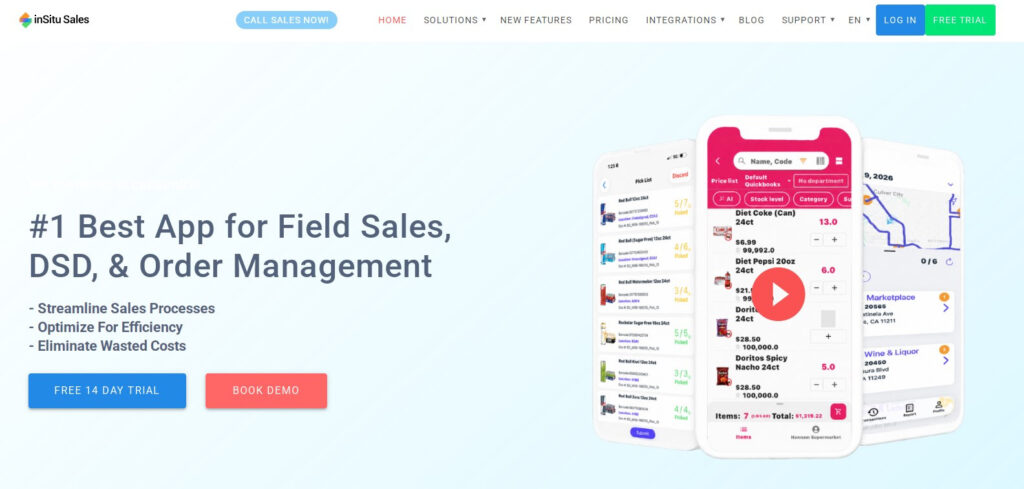
The platform connects three separate mobile apps. Reps use the field sales app to create invoices, estimates, and sales orders. They check product inventory and pricing before promising anything to customers. The warehouse app turns orders into picklists with barcode scanning. The dispatch app gives drivers optimized stop sequences with itemized delivery lists.
GPS tracking and route planning cut operational costs. Stripe processes credit and debit card payments through the app. Two-way QuickBooks Desktop and Online sync covers customers, items, inventory sites, price levels, sales orders, estimates, invoices, payments, and credit memos. The platform supports English and Spanish.
Route settlement gives managers full visibility into what happens on each delivery run. It shows which invoices got delivered, which got partially delivered, and which stops were missed entirely. Warehouse pickers see exactly which items to pull for each order. Drivers know exactly what to deliver at each stop.
What Sets It Apart:
- Three-app ecosystem for reps, warehouse pickers, and drivers
- Stripe payment processing built into the field app
- Two-way QuickBooks sync that covers the full order lifecycle
- Route settlement reports for reconciling planned vs actual delivery
- Barcode scanning for warehouse picking and order building
What Users Say:
Users consistently praise inSitu Sales for its ability to replace multiple tools with one system. One reviewer noted that the platform “has helped increase our sales team efficiency and daily workflow” by unifying field sales, delivery, and warehouse operations. Another user highlighted that the app “is very user-friendly and it helps simplify the sales process in the field.”
Multiple reviewers mention the platform’s effectiveness for route-based selling. The GPS tracking and route planning features receive particular attention, with users noting that “pre-planned delivery routes with GPS tracking, time-stamped activity” have improved field team accountability.
Some users point to challenges with customization and occasional technical issues. A few reviewers mentioned that invoice printing does not always work properly. Others noted that the Android version works differently from the iOS version. The platform has released updates addressing these issues, including improved visit error handling and new route settlement features.
4. Pepperi
Pepperi serves mid-market and enterprise CPG companies that need to connect online ordering with field sales and delivery. Founded in 2012, the platform handles eCommerce, field sales, order management, and route accounting in one system.
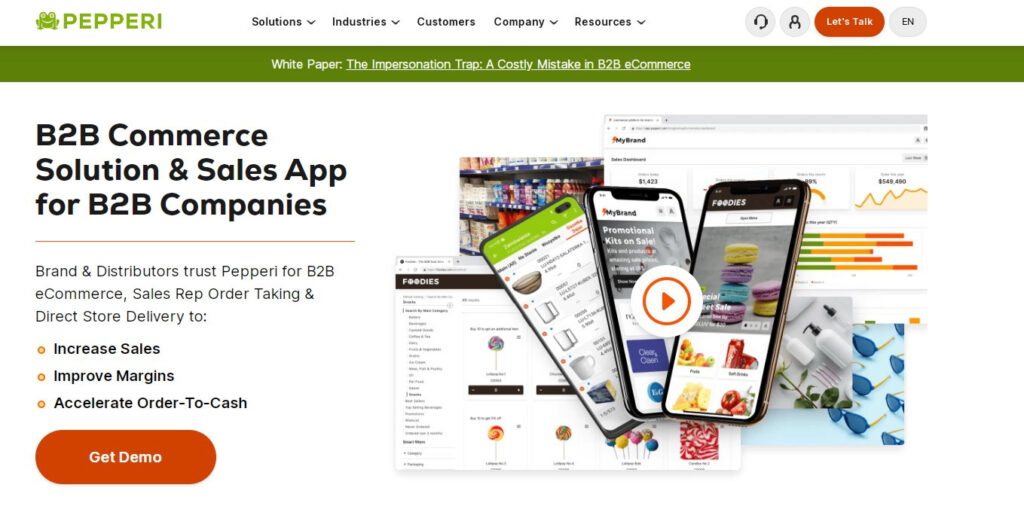
The field sales app works offline. Reps capture orders, and the data syncs when they regain connection. Retail execution includes merchandising audits, planogram checks, and photo proof. GPS and geofencing confirm that reps complete each scheduled stop.
The B2B portal gives customers access to their negotiated pricing and catalogs. Orders move from the portal into field sales and delivery without manual reentry. Trade promotions, mobile CRM, and inside sales support are all part of the workflow.
Pepperi operates across 70+ countries with over 1,000 customers. The platform handles 13 languages and multiple currencies. Security certifications include ISO 27001 and ISAE 3402.
What Sets It Apart:
- Unified omnichannel platform – B2B portal, field sales, retail execution, and DSD in one system
- Native mobile apps – iOS and Android with offline functionality
- Trade promotions engine – Cross-sell and up-sell through the storefront
- ERP-grade integrations – Pre-built connectors for SAP, NetSuite, Salesforce, QuickBooks, and Xero
- Global operations – 13 languages, multi-currency, and multi-country support
What Users Say:
Users consistently highlight Pepperi’s ERP integration capabilities and offline mobile functionality. One reviewer noted that Pepperi “integrates with all my QuickBooks and Salesforce apps really easily.” Another praised the platform’s “customizability” and ability to “retrofit to automate your sales operation.”
Multiple reviewers point to high costs for small businesses, with one noting the “price is too high for small businesses.” Several users mention that the back-end setup is challenging, and support availability is limited to CET business hours. Integration with QuickBooks has been described as having “frequent issues” by some users.
Scaling Field Sales and Delivery Operations
Scaling DSD operations requires more than adding reps and trucks. The systems that support field teams must scale with them.
- Order accuracy drops as volume increases. Manual entry creates errors. Errors create returns. Returns create costs. The best mobile sales and delivery app for field teams automates order capture to reduce these errors.
- Route efficiency suffers with growth. More stops mean more variables. Traffic, delivery windows, and load size all affect efficiency. Route optimization tools that account for these factors help scale operations without adding unnecessary mileage.
- Manager visibility decreases without automation. Field teams are spread across multiple territories. Managing them through spreadsheets becomes impossible. Real-time dashboards provide the visibility managers need to keep operations running smoothly.
- Customer expectations rise with scale. Faster delivery, accurate orders, and real-time tracking become the norm. Platforms with integrated proof of delivery and tracking meet these expectations.
Frequently Asked Questions
Field teams ask these questions during demos. Here are the answers.
How do I know when my DSD operation is ready to scale?
The signs appear gradually. Order volume increases beyond what reps can manually process. Route planning becomes reactive instead of proactive. Managers spend more time fixing errors than planning growth. Field teams start missing stops because the system can’t keep up.
Which features matter most for scaling field sales?
Offline capability keeps reps productive in low-signal areas. Real-time sync ensures the office sees what the field captures. Route optimization reduces mileage and increases stops per day. Proof of delivery eliminates disputes. QuickBooks integration removes manual data entry from accounting.
How do these platforms handle growth?
Each platform handles growth differently. SimplyDepo adds users without renegotiation. Skynamo scales across regions with multi-language and multi-currency support. inSitu Sales adds warehouse and dispatch apps as operations grow. Pepperi supports enterprise teams with complex ERP integrations.
What mistakes do distributors make when scaling?
Underestimating training needs is the most common mistake. Field teams need time to learn new workflows. Another mistake is scaling technology without scaling processes. A platform cannot fix broken workflows.
Final Thoughts
Scaling DSD operations requires platforms that grow with the team. Manual processes break down at scale. Disconnected systems create errors. Lack of visibility leads to inefficiency.
SimplyDepo offers the best all-in-one DSD and retail execution software for unified field sales, route planning, delivery, and retail execution. Skynamo provides international field sales coordination. inSitu Sales connects field sales, warehouse, and delivery. Pepperi delivers enterprise B2B commerce with DSD.
Each platform serves a different type of distributor. Team size, geographic scope, and integration needs determine the right choice. But all four provide the tools needed to scale DSD operations effectively.